From Blackwell's Island to Roosevelt Island
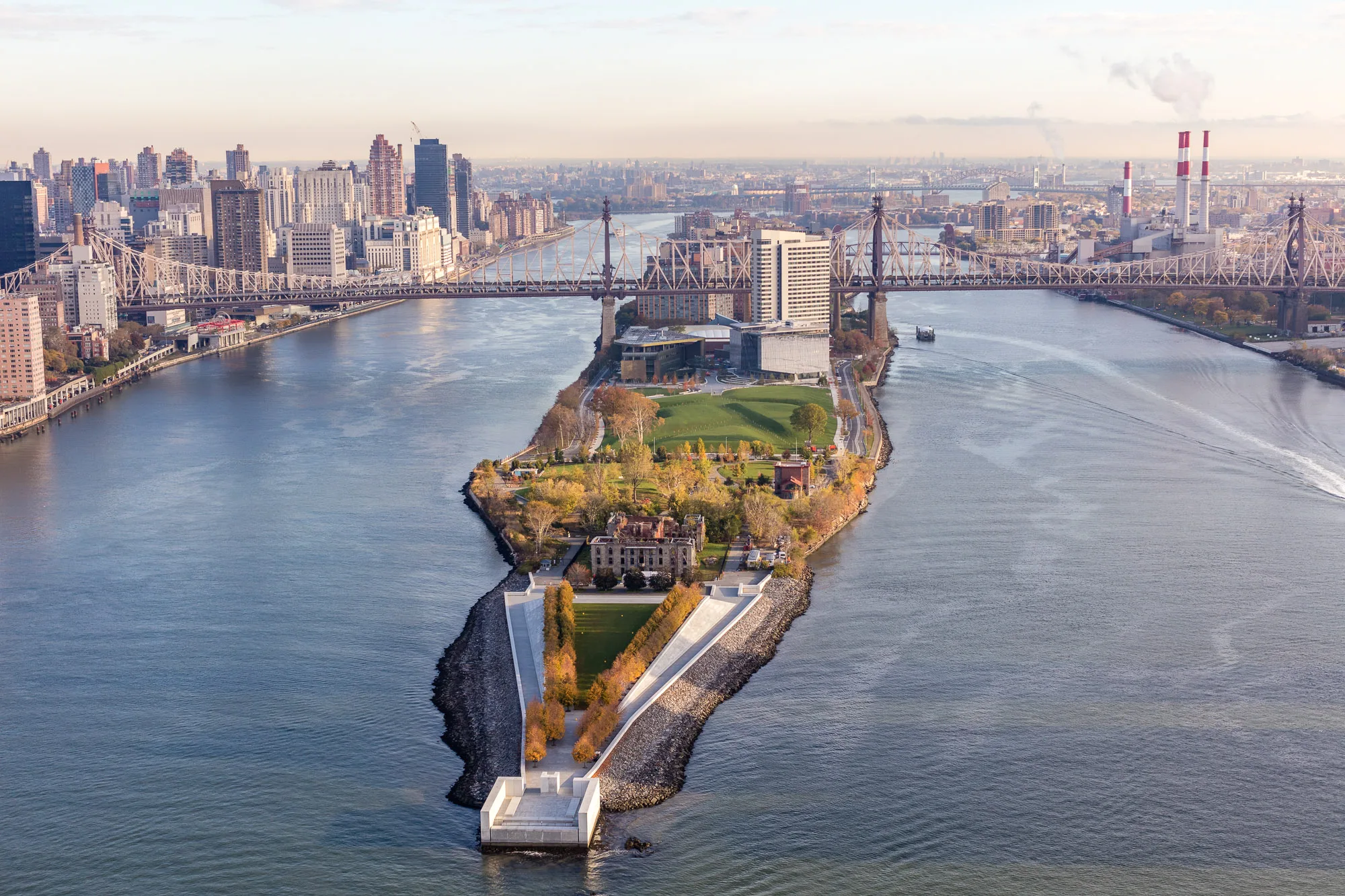
For more than a century, the island was home to New York City institutions, including a penitentiary, an asylum, a workhouse, an almshouse, and hospitals.
Beginning in the late 1960s, the island was redeveloped as a residential community. Many of the former institutions were demolished or converted, while new housing, parks, transportation, and public spaces were built.
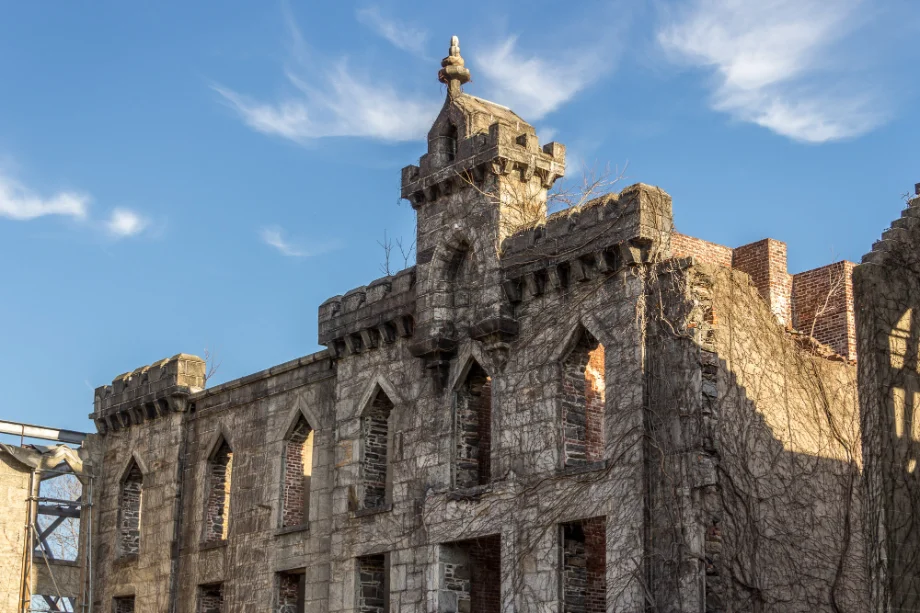
The Smallpox Hospital is one of the buildings that remains.
The island's names
Minnahanonck
Before 1686Blackwell's Island
1686—1921Welfare Island
1921—1973Roosevelt Island
1973—todayThe island was known as Minnahanonck before the Blackwell family acquired it in 1686.
The city called it Blackwell's Island until 1921, when it became Welfare Island.
In 1973, it was renamed Roosevelt Island.
Southpoint Park
The Smallpox Hospital stands at the southern end of Roosevelt Island, within Southpoint Park.
Immediately south is Franklin D. Roosevelt Four Freedoms State Park, designed by Louis Kahn and opened in 2012. Together, the two sites form a remarkable concentration of New York's architectural and public history.
The Smallpox Hospital was designed by James Renwick Jr. and completed in 1856 as a hospital for the treatment and isolation of people with smallpox.
Island chronology
-
Minnahanonck
Minnahanonck was an early name for the island, used by Indigenous people in the region.
-
The Blackwells
The Blackwell family farms the island until 1828. The Blackwell farmhouse, built around 1796, still stands near the center of the island.
-
The purchase
New York City purchases the island and begins developing it for municipal institutions, including prisons, asylums, and hospitals. Its location in the East River provided separation from Manhattan.
-
The Penitentiary
The New York City Penitentiary opens. Prison labor was used to construct many of the island’s institutions.
-
The Octagon
The New York City Lunatic Asylum opens, with a rotunda designed by Alexander Jackson Davis. Charles Dickens visits in 1842. The rotunda survives today as part of an apartment building.
-
The Smallpox Hospital
The Smallpox Hospital is completed at the southern end of the island. Designed by James Renwick Jr., it treats people with smallpox, including both charity and paying patients.
-
Nellie Bly
Journalist Nellie Bly has herself committed to the asylum on Blackwell’s Island and publishes Ten Days in a Mad-House. Her reporting leads to a grand jury investigation and increased funding for the city’s asylums.
-
Welfare Island
Blackwell’s Island is renamed Welfare Island. The island’s institutions increasingly focus on hospitals and long-term care. The penitentiary closes in 1935 and moves to Rikers Island.
-
A new plan
New York State’s Urban Development Corporation signs a 99-year lease with New York City to redevelop the island. Philip Johnson and John Burgee prepare a master plan for a new residential community.
-
Roosevelt Island
The island is renamed for Franklin D. Roosevelt. Louis Kahn is commissioned to design a memorial at the southern tip.
-
Housing
The first residents move into Island House, the first residential building of the island’s redevelopment. The other first-phase housing complexes follow in 1976.
-
The tram
The Roosevelt Island Tramway opens as a temporary connection to Manhattan, until a subway connection can be built. The subway finally arrives in 1990, but the tram has become a permanent part of the island’s transportation network. Ferry service eventually comes, too. The NYC Ferry begins serving Roosevelt Island in 2017, connecting the island to Manhattan, Queens, and Brooklyn.
-
Four Freedoms
Franklin D. Roosevelt Four Freedoms State Park opens at the southern tip of the island. Designed by Louis Kahn, the park commemorates Roosevelt and the four freedoms articulated in his 1941 address to Congress.
-
Cornell Tech
Cornell Tech opens on part of the former Goldwater Hospital site. The campus becomes another new use for land once occupied by the island’s institutions.
-
Roosevelt Island
Roosevelt Island is now a residential community with housing, parks, public institutions, and Cornell Tech. The Smallpox Hospital remains at its southern end.
The Smallpox Hospital is fenced off and is not open to the public.
Its walls require stabilization before the site can be opened.
Friends of the Ruin is working to preserve the building and make the site accessible to the public.